Clients
The client_id / client_secret pair a partner backend authenticates with.
What a Client Is
The server-side identity in the API access chain.
A Client is an OAuth-style identity pair — client_id plus client_secret — that a partner's server presents when it exchanges credentials for an application token. It is one link in the API access chain: the request's Origin resolves exactly one API key through its bound Webhook entry, and that key binds (each 1:1, each optional until wired) the Client that authenticates the partner's backend, the Certificate that signs its consumer tokens, and the Consumer Contract that governs its consumers. A client does nothing on its own — it earns its keep the moment an API key binds it.
Fully bound is the rule to keep in mind: an API key works for its partner only when a client, a certificate, a contract and a webhook entry are all wired. A key without a client is fully visible in the admin UI so you can finish wiring it — but its partner cannot reach the platform through it.
Credentials at a Glance
- client_id
kcid_followed by a random identifier. Public-ish: it identifies the client in the token exchange and in the certificate-code handshake. It is safe to log and reference — only the secret is secret.- client_secret
ksec_followed by a long random value. Shown exactly once at creation and once per rotation; afterwards only an 8-character display prefix remains visible. There is no recovery path — a lost secret means rotate.- Storage
- KeenAgents keeps only an irreversibly hashed copy of the secret plus the display prefix — the platform itself cannot re-display or recover it. A secret nobody can read back is a secret a data disclosure cannot leak.
- Binding
- A client is bound to an API key from the API key side — the "Pick a client" dropdown on the API key form. A client can be bound to at most one API key at a time, so every partner request always resolves to exactly one identity.
Rules & Limits
- Name: required,
1–100characters, unique. - Org-wide cap:
20clients, checked on create only. Creating past the cap returns400with a "Reached the maximum number of …" message — delete one first. The cap keeps the credential surface small enough to audit at a glance. - Secret display prefix:
ksec_+ the first 8 characters of the random part — the only fragment lists and detail pages ever show after the reveal. - When editing an API key, picking a different client re-binds it, clearing the selection unassigns it, and leaving the field untouched keeps the current binding.
- Deleting a bound client does not delete the API key — the binding is simply cleared. The key silently stops being fully bound and its partner loses access until a client is re-bound.
- Rotating a client secret retires the old secret at once for new application-token requests — a server still sending the old secret is refused. It does not revoke application tokens already issued: those are tied to the key ↔ client binding, not to the secret, so they keep verifying until the key is deleted, re-bound or unbound. If a leaked secret worries you, rotate it and, to cut existing tokens too, re-bind or delete the key.
- Changes take effect immediately everywhere on the platform.
The Application Token Exchange
Where the client_id / client_secret pair actually gets used.
The partner's server exchanges its client credentials for an application token — a long-lived signed token that fronts the public partner API. The three secrets are packed into one base64 string sent in the Authorization header; client_id rides the query string. There is no request body.
Paths shown as /v1/… are reached at https://<your KeenAgents host>/keen-api/… — the /v1 prefix is replaced by /keen-api.
- Method & path
POST /v1/auth/application_token?client_id=kcid_…- Headers
Origin— an allow-listed browser Origin, checked before anything else.Authorization— the bare base64 ofclient_secret | api_key_id | api_key_secret, with noBearer/Basicprefix.- Query & body
- Query:
client_id— thekcid_…Client id in the clear, which selects the secret to verify against (required). No request body.
Request
POST /v1/auth/application_token
POST /v1/auth/application_token?client_id=kcid_… Origin: https://app.yourcompany.com // must be allow-listed — checked first Authorization: <base64( client_secret | api_key_id | api_key_secret )> // bare base64 — no "Bearer" / "Basic" prefix // no request body // client_secret the raw ksec_… plaintext // api_key_id the API key's id (the Api Key ID on its detail page) // api_key_secret the raw kak_… plaintext
Response
200 — token minted
200 OK { "success": true, "status": 200, "message": "Success", "result": { "type": "Bearer", "access_token": "<signed token — send as Bearer on the partner API>" } }
On success the token is returned at result.access_token as a Bearer credential valid only for the partner API — it can never be used as an admin credential. It has no expiry and no refresh: revocation is by state (delete the API key, or break the chain), not by clock, so cutting a partner off is immediate and does not wait for anything to time out. If a token stops verifying, simply request a new one.
Failure modes
- no response
- The
Originis not on the allow-list. The connection is dropped before any authentication — no status, no body — so on your side it surfaces as a connection reset or a generic proxy error. An unknown caller never even learns the endpoint exists. Recover by calling from an allow-listed Origin. - 500 — Invalid request
- Uniform and opaque on every credential problem — wrong
client_secret, wrongapi_key_secret, unknownclient_id, the API key not bound to that client, a malformed triple, or a half-wired key (certificate / contract / webhook not all bound). It is also returned whenclient_idorAuthorizationis missing. The caller is never told which part failed — a failed guess reveals nothing. Recover by re-checking all three credential parts and confirming the key is fully wired (an operator task, not a partner-side bug).
The client_id also drives the certificate-code handshake: the partner requests a one-time code with its client_id, and KeenAgents re-verifies the API key ↔ client binding before delivering the certificate PEM to the key's webhook URL.
In the Admin UI
- Clients are their own entry in the sidebar's Api group, with list, create and detail pages, gated by the Clients scope — read to view clients, write to create, rename, rotate or delete them. Binding a client to a key happens on the API key form and needs API Keys write.
- The client_secret appears in a one-time reveal panel on create and on rotate; afterwards only the
ksec_display prefix is visible anywhere. - Rotate Secret lives in its own card below the form and confirms (Confirm rotate / Cancel) — it mints a new secret in place: same client, new secret, revealed once.
- Binding happens on the API key form: the "Pick a client" dropdown offers unassigned clients, plus the currently bound one when editing.
- A client rename or secret rotation automatically sends the bound key's notification URL a refresh notice (
r_api_keys). If the partner must also receive its certificate material again, press Rebuild Resource Cache and then Wake on the key. A missed notice is recovered on the partner's next fetch. - A Rebuild Resource Cache button in the footer rebuilds the served copy of all clients (the Cache page has no card for clients — this button is the only place to do it). It appears only for roles with Cache write, independently of the Clients scope. You rarely need it — a save refreshes the copy on its own; to refresh everything one partner reads, use Rebuild Resource Cache on its API key (the cascade) and then Wake.
- Also available to an AI agent through the Keen MCP Server:
list_clients,get_client,create_client,update_client,rotate_client,delete_client— same scope, same rules.
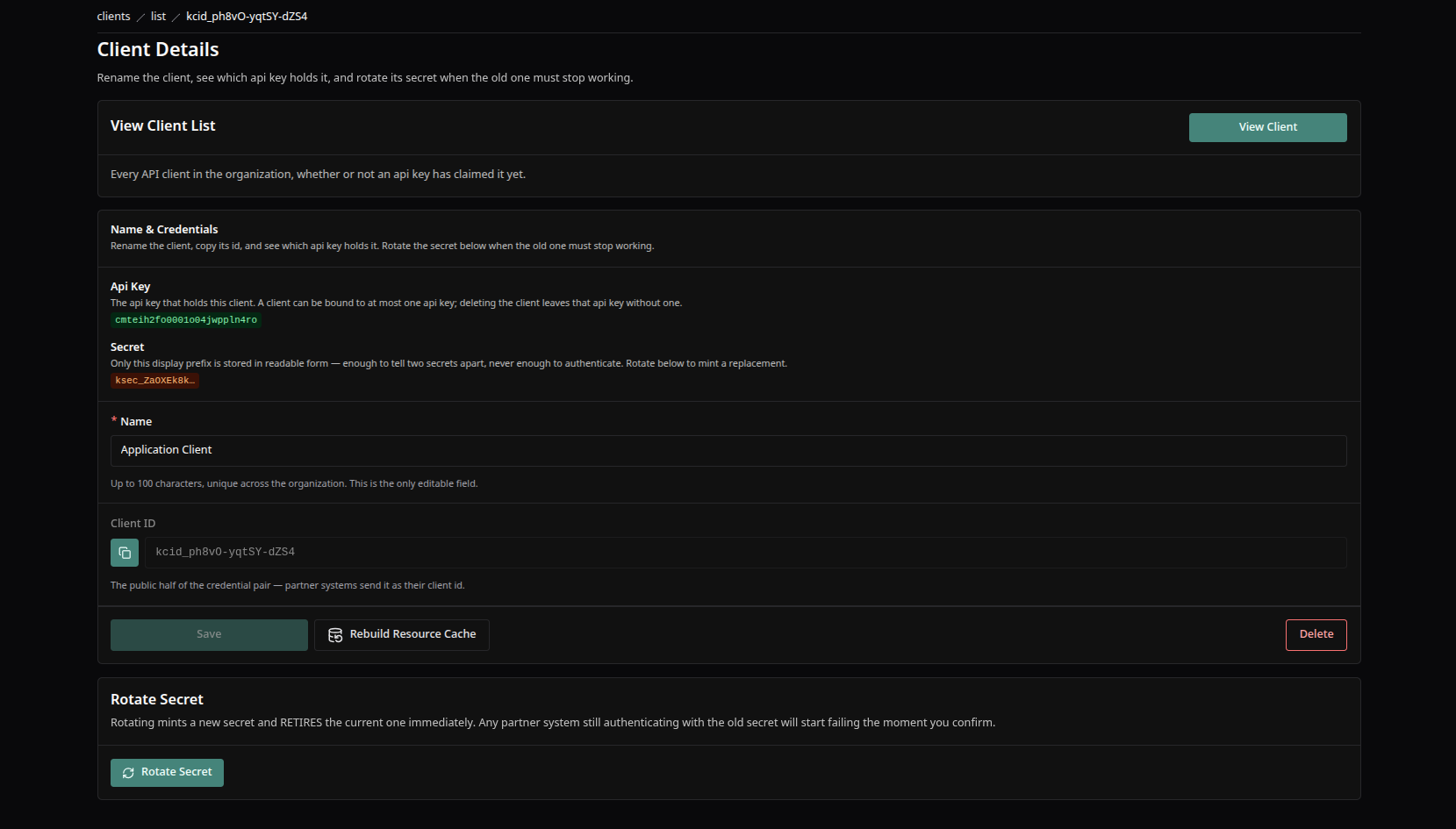
A client's detail screen — the key holding it, the masked secret prefix, its name and client id, the Save · Rebuild Resource Cache · Delete footer, and the Rotate Secret card below.
Good to Know
500 Invalid request every other credential problem returns. The admin list still shows the key as a partial row — the admin view is the only place to see and finish partial wiring.Keen Agents 2026
Documentation
Release 15